
Documentation
Canonical architecture, evaluation logic, and method referenceMethod reference (bibliometrics & cohort logic)
Item & group oriented indicators
Our bibliometric indicators are categorized into two types: item-oriented and group-oriented. Item-oriented indicators are calculated for individual publications, such as citation counts or the nature of the publication (international, lead-authored, etc.). These reflect direct attributes of a publication.
In contrast, group-oriented indicators require aggregating data across multiple publications by an author, such as total publication counts. These indicators provide a broader view of a researcher’s output and influence, necessitating grouping publications according to specific criteria to ensure accurate assessment.
Item-oriented indicators
Among the item-oriented indicators, citation counts are particularly complex due to the varying citation practices across disciplines, document types, and publication ages.
Number of citations
Citations are a fundamental measure of a publication’s influence. The number of citations a publication receives can vary significantly based on:
- Research field: citation norms differ substantially across disciplines.
- Type of document: reviews tend to accumulate more citations than articles.
- Publication age: older publications have had more time to accumulate citations.
To account for these variables, we rank publications by their citation count within their respective categories (type, year, discipline) and calculate percentiles to assess their relative impact.
Ranking publications by citations
We create rankings by grouping publications within each field by discipline, document type, and publication year. Each publication is placed in a percentile within its cohort, allowing us to identify:
- Highly Cited Papers (HCP): publications ranking between the 90th and 99th percentiles.
- Outstanding Papers (OP): publications at or above the 99th percentile.
Expected values: reference values
In bibliometrics, reference values help determine whether an indicator for a publication or author stands above or below average. These values are crucial due to the asymmetric distribution typical of bibliometric data.
- Mean: often used, but affected by extreme values common in citation counts.
- 90th percentile: used to define Highly Cited Papers.
- 99th percentile: used to define Outstanding Papers.
Authors’ indicators
Group-oriented indicators aggregate an author's bibliometric data to provide insights into their overall research output and influence. These indicators require the compilation of all publications attributed to an author, which involves complex identification processes.
Identifying the actual researchers
Correctly associating publications to authors is a challenge due to name synonyms and homonyms. With systems like ORCID and our own algorithms, accuracy improves substantially, though minor discrepancies may remain and can often only be resolved by researchers themselves.
Counting method
Each publication attributed to an author counts fully towards their total output. This total count method reflects the collaborative nature of scientific work.
Main field and years of scientific activity
Authors are assigned to fields based on the most frequent classification of their publications, with secondary disciplines allowed where relevant. Years of scientific activity are calculated from the first to the last publication.
Comparing authors’ indicators
The process of comparing authors within the ONE Index is designed to ensure fair and contextually relevant assessment by considering similar cohorts of researchers.
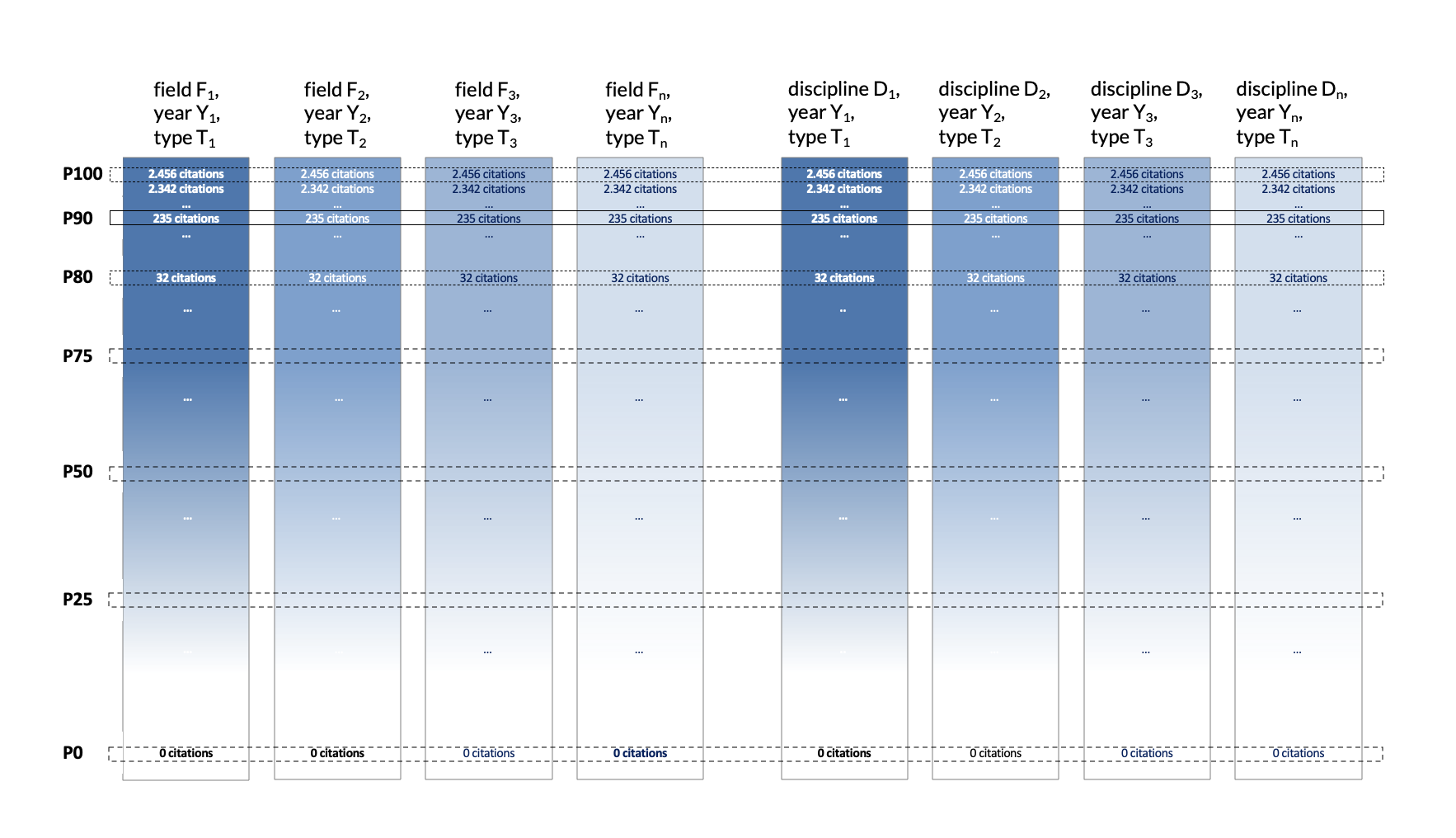
Cohort definition
Researchers are grouped into cohorts based on:
- Research field: OpenAlex field/subfield taxonomy.
- Years of activity: years since first recorded publication (career-stage proxy).
Scoring system
- 1) Rank per indicator – Cohort values are ordered; rank position becomes indicator score.
- 2) Dimension score – Indicator ranks aggregated within each dimension.
- 3) ONE Index – Dimension scores aggregated into final score.
- 4) Custom weights – Optional weights at indicator/dimension level.
Dynamic adjustment
- Adaptive weights: weights can evolve with standards and stakeholder needs.
- Flexible cohort windows: narrower windows for early-career; broader for senior cohorts.
Structure of the ONE Index
The ONE Index is a weighted measure that captures the breadth and depth of a researcher’s contributions across dimensions of academic and societal impact. At the heart of the framework are three supra-dimensions: Performance, Interaction within the Scientific Community, and Interaction with Society.
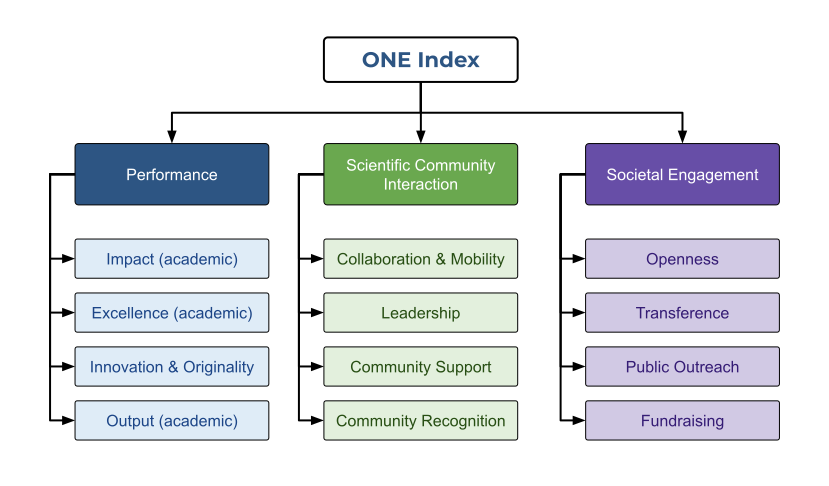
*Currently in development.
Handouts & Quick Guides
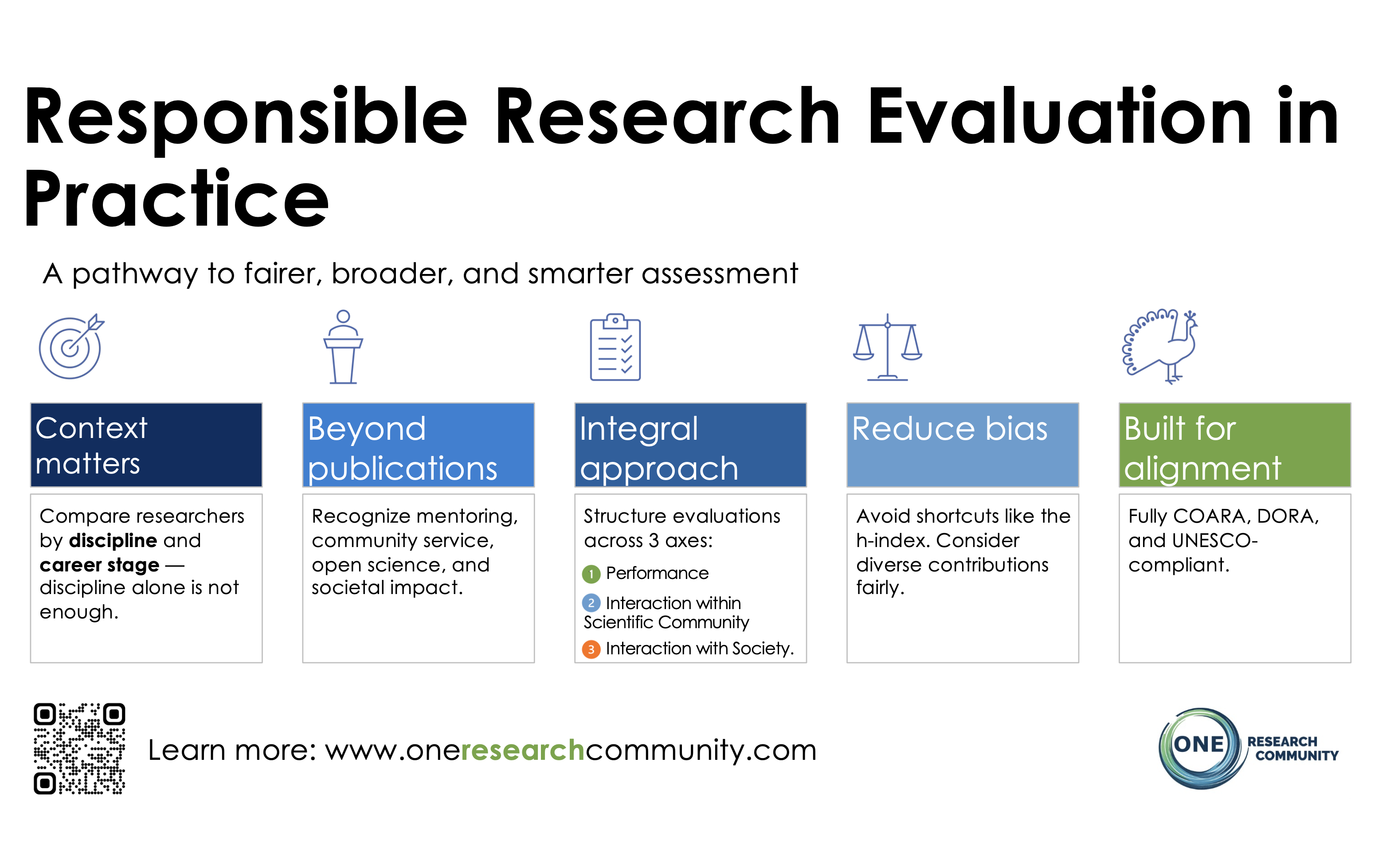
Fair, Inclusive & Smarter Evaluation
Discover how the ONE Framework redefines research assessment beyond outdated metrics.
ONE Framework
Get to know our integral, fair & transparent research assessment: 3 axes, 11 dimensions & 70+ indicators behind the ONE Index.
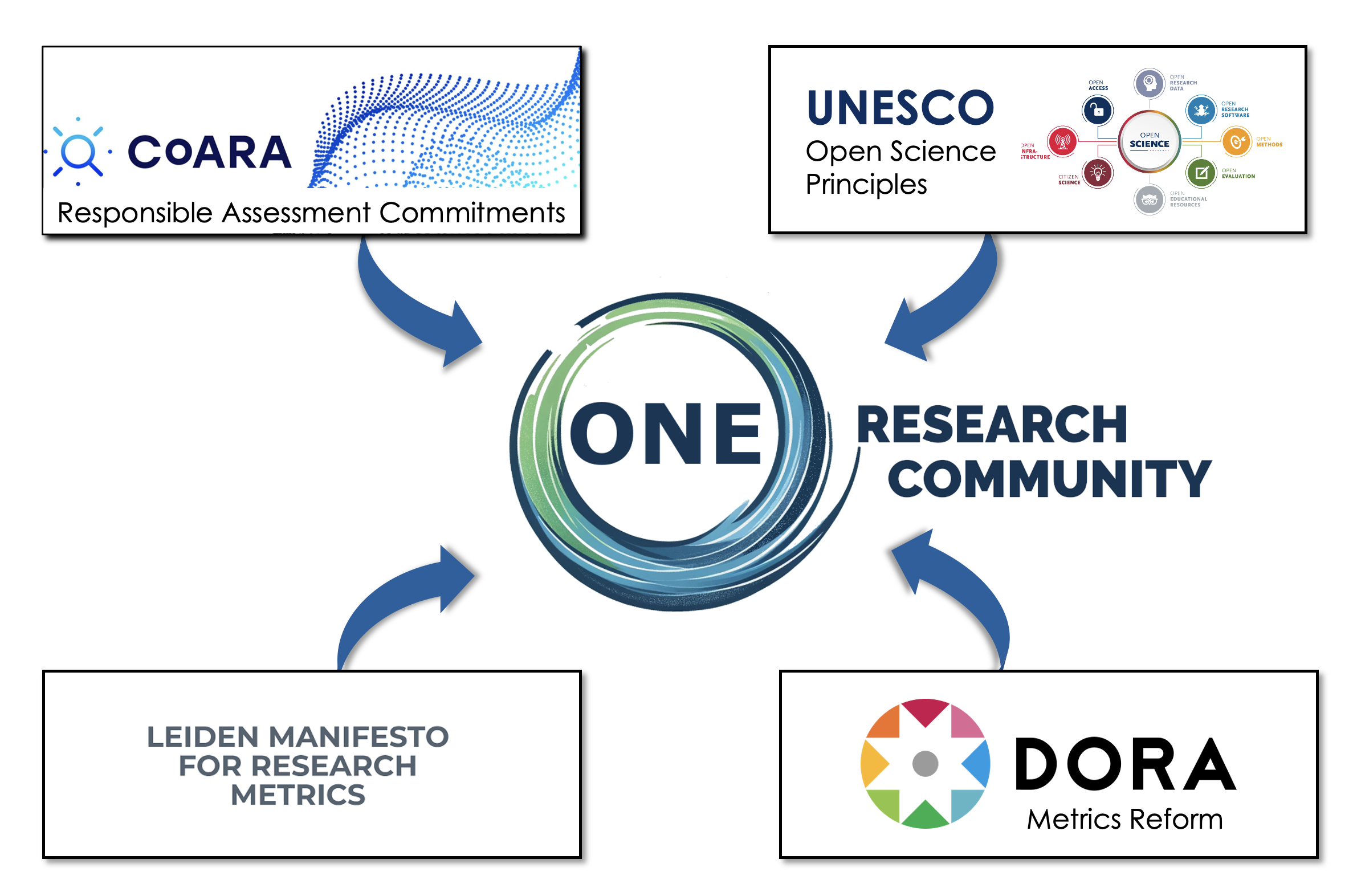
From Principles to Practice: ONE’s Global Alignment
ONE integrates principles of COARA, UNESCO, DORA, and the Leiden Manifesto into a single operational framework.
Postdoc Benefits with the ONE Framework
Guiding early-career researchers toward fairer, smarter career moves.
Badges & Recognition
TL;DR
- Badges make profile information visible and interpretable.
- They reflect system status, declared roles, professional development, or public commitments.
- Badges are optional and not rankings or quality scores.
- Most badges are unlocked by completing profile sections or accepting pledges.
- Badges help others quickly understand who you are, what you do, and what you stand for.
Badges in ONE Research Community highlight profile status, declared roles, professional development, and public commitments. They are designed to make profile information more visible and interpretable, promote transparency and responsible research practices, and encourage meaningful profile completion.
Badges are optional and are not rankings or quality scores.
What badges are (and are not)
Badges are:
- Signals derived from declared information, system status, or public commitments.
- Visible markers that help others understand a researcher’s profile at a glance.
Badges are not:
- Performance evaluations.
- Quality rankings.
- Endorsements by ONE or third parties.
Badge categories
Badges are grouped into four categories, each with a distinct meaning:
- Profile status – System-recognised states related to profile identity and trust.
- Commitments & transparency – Voluntary public commitments and contextual information.
- Roles & contributions – Declared roles and activities (peer review, mentoring, advising, entrepreneurship).
- Development & profile completeness – Signals related to structured self-reflection and competence-based development.
Badge examples
Below are examples of badges available in ONE Research Community. Some badges may appear greyed out until the corresponding profile information or commitment is completed.

Claimed Profile
System status
Referred Profile
Peer recognition
Validated Profile
Higher peer validation

Trusted Contributor
Sustained contribution

Integrity Pledge
Public commitment
Zero Tolerance
Public commitment
Publication Record Validated
Data stewardship
Affiliations Validated
Data stewardship

Inclusion Supporter
Community support

Career Interruption Aware
Context & transparency

Registered Reviewer
Declared role

Declared Mentor
Declared role

Declared Advisor
Declared role

Entrepreneur
Declared activity

Competence Profile
Structured self-assessment
Badge list
Profile status
- Claimed Profile – Profile has been claimed and confirmed by the researcher.
- Referred Profile – Profile has been recognised by peers within the community.
- Validated Profile – Profile has reached a higher level of peer validation.
- Trusted Contributor – Recognised for sustained positive contributions to the research community.
Commitments & transparency
- Integrity Pledge – Public commitment to responsible research practices and ethical conduct.
- Zero Tolerance – Commitment to zero tolerance for harassment, discrimination, and abuse in research environments.
- Publication Record Validated – Researcher completed a publication review flow; validation remains current.
- Affiliations Validated – Researcher completed an affiliation review flow for the common affiliations block; validation remains current.
- Inclusion Supporter – Reports activities supporting inclusion, mentoring, and career development of others.
- Career Interruption Aware – Provides contextual information on interruptions to support fair evaluation.
Roles & contributions
- Registered Reviewer – Declares availability and eligibility to participate in peer review.
- Declared Mentor – Declares mentoring or supervision of early-career researchers.
- Declared Advisor – Declares advisory or senior guidance roles.
- Entrepreneur – Declares entrepreneurial or venture-related activity.
Development & profile completeness
- Competence Profile – Indicates completion of a structured competence self-assessment.
How badges are obtained
- Claiming and completing profile sections.
- Submitting specific forms (e.g. reviewer preferences, competences).
- Accepting public pledges.
- Reporting relevant professional activities.
Data sources & transparency
Badge states are derived from structured profile data entered by the researcher, system events (such as profile claiming), and publicly accepted commitments. The underlying data remains accessible and editable by the profile owner.
Badges reflect declared information, public commitments, or system status. They are not rankings or quality assessments.
